
Most linen suppliers sell you on thread count because it's the number that's easy to market. It's the wrong place to start. The two things that actually determine which weight you need are how the linen gets washed and what climate it dries in — and for a property portfolio, the wash question usually matters more than the weather.
Start with how it gets washed, not where it is
Every property we supply falls into one of two washing realities, and it changes the spec before climate even enters the conversation.
Host washes on a domestic machine
Common for single-listing or small-portfolio STR hosts. A lighter 140–160 GSM percale performs well here — it dries faster between guest turnovers on a home machine and doesn't need to survive industrial heat.
Linen hire or contract laundry, 75°C cycles
PM companies running multiple properties, hotels, motels, and anyone using a commercial laundry contractor need the full 160–200 GSM, 180–300 TC grade — built to survive repeated high-heat alkaline wash cycles without pilling or shrinking.
If you manage more than a handful of properties, you're almost certainly in the second category, regardless of climate — get the commercial-wash grade and treat GSM range as the finer decision.
Then adjust for climate and guest expectations
Within whichever wash-grade you need, climate and property type shift you toward the lighter or heavier end of that GSM range.
Humidity is the deciding factor. Long-staple cotton percale breathes well on its own — going heavier here doesn't add durability, it just traps heat and slows drying between changeovers.
Breathability matters less when it's cooler. This is where the durability case for a heavier weight is clearest — more wash cycles before it needs replacing, without a comfort trade-off.
Big day-to-night temperature swings favour cotton's natural insulating range — breathable in daytime heat, warm enough for a cold desert night. A mid-weight percale covers both without overcompensating.
Where hand-feel is part of the guest experience — boutique hotels, premium STR listings — climate takes a back seat to how the sheet feels on first touch. Spec toward the top of the range.
GSM vs thread count, plainly
These measure different things, and only one of them is easy to fake.
| Metric | What it actually measures | Why it's harder to game |
|---|---|---|
| GSM (grams per square metre) | The physical weight and density of the woven fabric — a direct measure of how much cotton is actually in the sheet. | Hard to inflate without changing the real weight of the material — a physical, checkable number. |
| Thread count (TC) | How many threads are woven per square inch — but multi-ply threads can be counted as two or more, inflating the number without adding real quality. | Easy to market past 400–600 TC using thin, twisted multi-ply yarns that don't actually improve feel or durability. |
Where towels follow a simpler rule
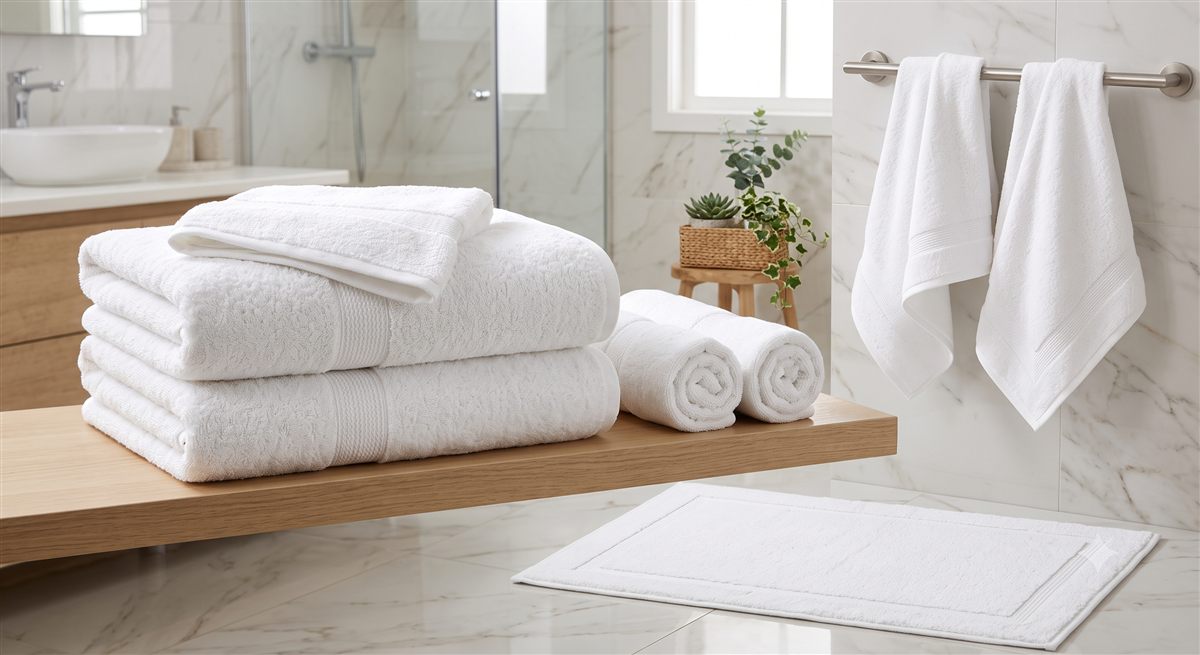
Bath linen doesn't have the same climate-driven trade-off as sheets — 500–600 GSM ring-spun or combed cotton is the settled commercial standard across climates, because towel absorbency and durability under commercial wash matter more than regional breathability. The one exception is turnover speed: a high-volume STR portfolio with fast changeover windows may prefer the lower end of that range for faster drying between guests.